The Wanderer
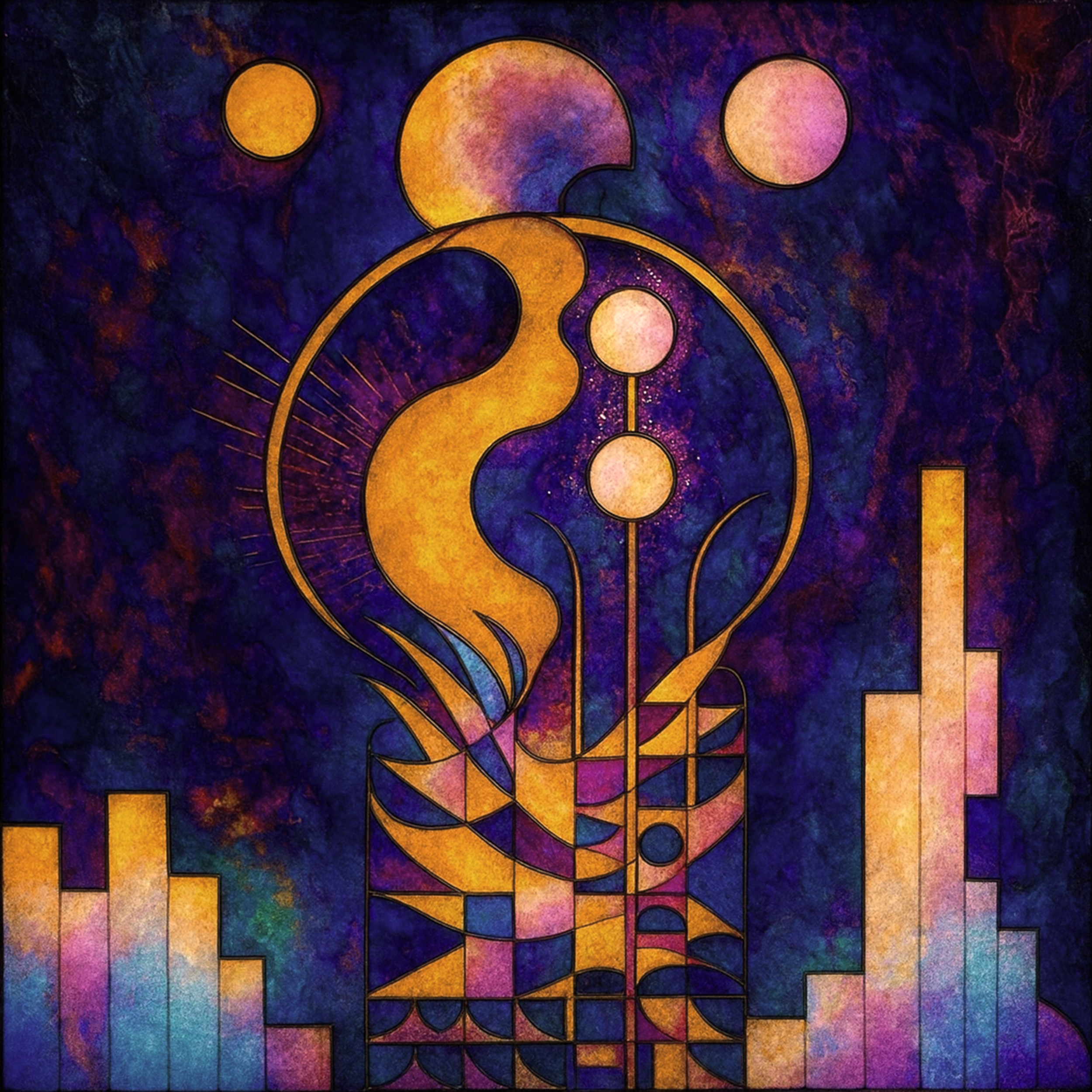
Primary Seed: "Liminality" aligns with the Wanderer archetype, representing the in-between state of transition, where one is neither fully here nor there. In this artwork, the figure’s solitary position on a checkerboard path, framed by a large dark circle and open windows, embodies the essence of liminality—existing in a threshold state that bridges the known and the unknown.
In The Wanderer, liminality is depicted through the checkerboard pattern beneath the figure, which suggests a journey that requires careful navigation. The pathway, alternating between light and dark, mirrors the uncertainties and shifts inherent in transitional spaces. This liminal path challenges the Wanderer to embrace the ambiguity, taking steps without the assurance of a clear destination.
The surrounding circular form emphasizes the concept of being between worlds. The dark sphere overhead, evocative of a distant moon or a portal, reinforces the feeling of stepping into the unknown, a hallmark of the liminal experience. This celestial body hints at introspection and solitude, encouraging the Wanderer to look inward as they move through uncharted territory.
The grid-like structure of the background, with its clean lines and empty spaces, symbolizes potential and openness. It suggests a space that is yet to be defined, a blank slate awaiting the Wanderer’s presence to bring meaning. This openness reflects the essence of liminality, where the future remains undefined, holding both the promise and challenge of transformation.
From a Jungian perspective, liminality represents the Wanderer’s journey into the unconscious, exploring the boundary between the self and the unknown. This transitional space invites self-discovery, where the Wanderer must confront their fears and desires to navigate the path ahead. The artwork serves as a reminder that growth often requires embracing the spaces between, allowing oneself to wander in order to find new insights.
Through these elements, The Wanderer captures liminality as the defining quality of the archetype, illustrating the journey through uncertain, transitional spaces. This artwork encapsulates the Wanderer’s role in embracing the threshold, showing that true understanding and transformation often arise when one dares to step into the unknown.
For Kayle
Description of The Wanderer
The Wanderer symbolizes the restless soul that is always on the move, driven by a deep longing for freedom, adventure, and the discovery of new horizons. Fueled by a desire to break away from the familiar, The Wanderer embraces the journey into the unknown and the exploration of hidden aspects of the self. Yet, The Wanderer often grapples with feelings of solitude, uncertainty, and the challenge of finding a place to call home.
The Wanderer represents the archetype of the eternal seeker—an individual who is compelled by a powerful need to explore both the outer world and their own inner landscapes. Their journey is one of self-discovery and transformation, constantly evolving as they encounter new ideas, challenges, and experiences. The Wanderer’s path is rarely straight or clear; they thrive in the ambiguity of life’s twists and turns, yet often struggle with a sense of rootlessness and the inability to find lasting contentment. While they may appear detached or isolated to others, The Wanderer finds meaning in the journey itself, embracing every detour as an opportunity for growth and insight.
Characteristics of The Wanderer
Discovery: The capacity to uncover deeper truths and insights through the journey, finding meaning in the experiences along the way.
Exploration: A relentless curiosity to venture beyond the known, seeking out new places, perspectives, and knowledge that lead to self-discovery.
Freedom: The ability to live life on one’s own terms, breaking free from societal expectations to follow a personal path of exploration and growth.
Challenges Faced by The Wanderer
Detachment: Emotional distance from people and places, resulting in a sense of isolation or difficulty forming lasting connections.
Restlessness: An inability to settle down or find satisfaction, constantly seeking new horizons without fully appreciating the present.
Uncertainty: A struggle with ambiguity and lack of clear direction, leading to moments of doubt or feeling lost in one’s journey.
Symbolic Imagery Associated with The Wanderer
Changing Landscapes: Diverse terrains and shifting environments reflect The Wanderer’s adaptability and their ability to navigate the constant changes in their internal and external worlds.
Travel Gear and Simplicity: Simple travel items like a worn backpack or walking stick represent The Wanderer’s practical approach to life, emphasizing self-reliance and minimalism.
Paths and Uncharted Roads: The imagery of winding trails and unexplored paths symbolizes The Wanderer’s journey through the unpredictable landscape of life, highlighting their quest for meaning.
Dreaming of The Wanderer
Journey of Self-Discovery: Encountering The Wanderer in dreams may reflect the dreamer’s personal journey toward self-awareness, hinting at a need for inner growth and understanding.
Quest for Freedom: Dreaming of The Wanderer often signifies a longing for independence and liberation from restrictions, highlighting a desire to explore uncharted territories in one’s life.
Restlessness and Seeking: A dream of The Wanderer might symbolize an unsettled state of mind, pointing to a search for purpose or direction amidst life’s uncertainties.
Cultural References Aligned with The Wanderer
Year: ~8th Century BCE
Title: The Odyssey
Author: Homer
Quote: "I long for home, long for the sight of home."
Explanation: Odysseus represents the Wanderer archetype through his prolonged journey filled with trials and self-discovery as he strives to return to Ithaca. The quote reflects his continuous movement and the personal growth he experiences, embodying the Wanderer's quest for understanding through exploration.
Year: 1812 CE
Title: Childe Harold's Pilgrimag
Author: Lord Byron
Quote: "I stood among them, but not of them; in a shroud of thoughts which were not their thoughts."
Explanation: Childe Harold embodies the Wanderer as he travels through foreign lands, feeling detached from society. The quote illustrates his sense of isolation and introspection during his journey, highlighting the Wanderer's search for identity and meaning beyond conventional boundaries.
Year: 1969 CE
Title: The Left Hand of Darkness
Author: Ursula K. Le Guin
Quote: "It is good to have an end to journey toward; but it is the journey that matters, in the end.”
Explanation: Estravan embodies the Wanderer through their journey across the icy landscape of Gethen with Genly Ai. Estravan abandons societal expectations and gender norms, reflecting the Wanderer's search for identity and understanding in a world that offers no clear acceptance or resolution.
Year: 1957 CE
Title: On the Road
Author: Jack Kerouac
Quote: “The road is life.”
Explanation: Sal Paradise embodies the Wanderer by traveling across America, driven by an insatiable longing for adventure and meaning. His journey symbolizes the Wanderer's pursuit of freedom from societal norms, with an emphasis on exploration both outwardly and within the self.
