The Forest
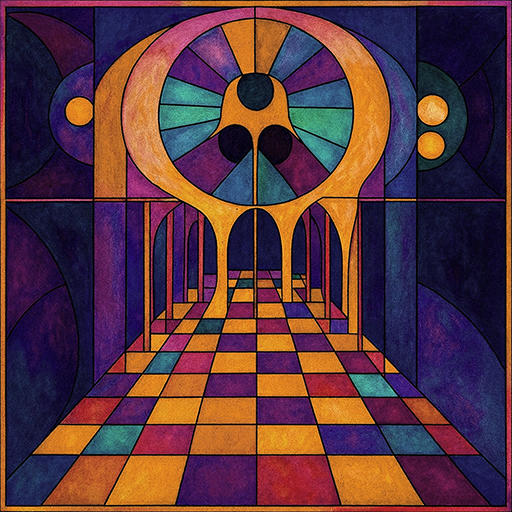
Primary Seed: "Iteration" captures the essence of the Forest archetype as progress through repetition rather than direct advance. In mathematics and philosophy, iteration describes a process that unfolds through repeated engagement, where each pass alters understanding without resolving it completely. Symbolically, the Forest operates in this way: movement continues, patterns recur, and orientation is shaped gradually rather than decisively.
The Forest is not defined by arrival, but by ongoing traversal. Meaning emerges through return, adjustment, and accumulation. What is learned here is learned incrementally, through sustained contact rather than singular insight.
For Kayle
Description of the Forest
The emotional atmosphere of the forest is immersive and absorbing. Sensory input multiplies—sound layers, light filters unevenly, and depth becomes difficult to judge. Forward movement is possible, but rarely straightforward. Attention shifts constantly, drawn by subtle changes rather than clear signals.
Being in a forest can feel sheltering or disorienting. Familiar reference points dissolve, replaced by proximity, texture, and intuition. Progress is often measured not by distance covered, but by endurance—by the ability to remain present without certainty.
Emotionally, the forest is where persistence replaces clarity.
Symbolic Attributes of the Forest
Recursion: Represents repeated encounter with similar conditions that slowly alter understanding.
Immersion: Symbolizes being surrounded by complexity without clear overview.
Accumulation: Reflects growth through layering rather than breakthrough.
Disorientation: Indicates loss of linear direction or fixed reference.
Fertility: Marks the generative capacity of sustained engagement.
Adaptation: Represents learning through response rather than control.
Aesthetic Values of the Forest
Dense Vegetation:
Layered growth creates visual complexity, emphasizing depth, obstruction, and richness.Light and Shadow:
Filtered illumination produces partial visibility, reinforcing uncertainty and gradual revelation.Pathways and Clearings:
Irregular paths and open spaces contrast compression with relief, marking moments of temporary orientation within complexity.
Dream Indicators of the Forest
Prolonged Searching: Suggests engagement with unresolved questions or long-term processes.
Loss of Direction: Reflects uncertainty about goals, identity, or next steps.
Tolerance for Ambiguity: Indicates developing comfort with incomplete understanding.
Emergent Insight: Signals awareness forming slowly rather than arriving suddenly.
Need for Endurance: Points to situations requiring patience rather than decisive action.
Cultural References Aligned with The Forest
Year: ~13th century CE
Title: Mirkwood (Myrkviðr)
Source: Norse Mythology
Quote: “"Mirkwood, the dark and enchanted forest, lay ahead—a realm where few dared to venture."
Explanation: Mirkwood is depicted as a vast, dark forest filled with unknown dangers and magical beings. It symbolizes the mysterious and daunting aspects of the unknown. In Jungian terms, the forest represents the unconscious mind with all its hidden fears and potentials. The hero's journey through Mirkwood reflects the individual's confrontation with the shadow self and the challenges inherent in personal growth and self-discovery.
Year: 1320 CE
Title: Inferno (Part of The Divine Comedy)
Source: Dante Alighieri
Quote: “Midway upon the journey of our life I found myself within a forest dark, for the straightforward pathway had been lost.”
Explanation: In Dante's Inferno, the forest symbolizes the Jungian archetype of the Unconscious Mind, representing the unknown depths and complexities within oneself that must be explored for personal transformation. Dante’s journey begins lost in a dark forest, reflecting a crisis of identity and the commencement of a profound inner voyage toward self-realization and individuation.
Year: 1841
Title: Self-Reliance
Source: Ralph Waldo Emerson
Quote: “In the woods, we return to reason and faith.”
Explanation: Emerson sees the forest as a place of reconnection with oneself and higher truths, aligning with the Jungian Forest archetype as a realm of introspection and renewal.
Year: 1854
Title: Walden; or, Life in the Woods
Source: Henry David Thoreau
Quote: "I went to the woods because I wished to live deliberately, to front only the essential facts of life."
Explanation: Thoreau's retreat into the forest signifies a deliberate journey toward simplicity and self-reflection. The forest serves as a sanctuary away from societal distractions, allowing for introspection. In Jungian terms, the forest symbolizes the unconscious mind—a place to confront one's inner self. Thoreau's experience embodies the individuation process, seeking authenticity and deeper understanding through communion with nature and solitude.
