The Wall
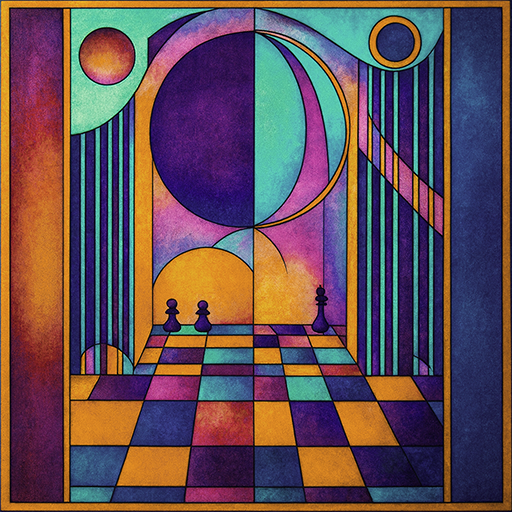
Primary Seed: "Boundary" captures the essence of the Wall archetype. the concept of a boundary is powerfully illustrated through the towering vertical columns and the central, divided circular form. In physics and philosophy, a boundary denotes a separation, a limit that defines two distinct spaces or states. Here, the wall embodies the idea of a boundary as both a physical and psychological barrier that restricts and protects. What lies beyond the boundary can only be accessed or understood by those who dare to confront it.
The split circle symbolizes a perceived duality and choice, inviting the viewer to contemplate what might be hidden or inaccessible beyond this divide. The archetype of The Wall teaches that boundaries can serve as both limitations and points of transformation. By examining our own boundaries, we learn to respect them as integral to our structure yet recognize the power in crossing them when necessary. The artwork thus becomes a visual meditation on the boundaries we set, both seen and unseen, as essential constructs of self and society.
For Kayle
Description of The Wall
The Wall feels immovable and impersonal. It creates pause. Encountering it brings a sense of halt, tension, or relief—sometimes all at once. It can feel protective, offering shelter from intrusion, or oppressive, cutting off movement and contact. The Wall introduces stillness where momentum once existed, forcing attention onto what cannot be crossed, avoided, or ignored. Presence before the Wall heightens awareness of limits—of endurance, patience, and resolve.
Symbolic Attributes of The Wall
Boundary: Establishes separation that defines identity, territory, or state.
Defense: Maintains internal integrity by preventing intrusion or exposure.
Constraint: Imposes limitation that restricts movement or possibility.
Resistance: Active opposition to pressure, change, or external demand.
Fixation: Immobilization caused by rigid adherence to limits.
Division: Sustained separation that prevents integration or exchange.
Aesthetic Values of The Wall
Vertical Mass: Emphasizes impenetrability and authority through scale.
Surface Texture: Communicates age, wear, or reinforcement over time.
Repetition of Form: Suggests persistence and uniform enforcement.
Negative Space: Highlights absence of passage, directing attention to blockage.
Dream Indicators of The Wall
Psychic Defensiveness: Emerges when the ego reinforces boundaries to protect against intrusion or overwhelm.
Blocked Progress: Reflects a felt halt in inner movement, often linked to unresolved conflict or resistance.
Fear of Exposure: Indicates anxiety around vulnerability, intimacy, or revealing inner content.
Isolation Drive: Signals withdrawal as a means of self-preservation rather than avoidance.
Boundary Testing: Appears when the psyche is approaching a limit that may need to be examined, reinforced, or crossed.
Cultural References Aligned with The Wall
Year: Classical Antiquity (~1st century BCE)
Title: Pyramus and Thisbe
Source: Roman Mythology (Ovid's Metamorphoses)
Quote: "They discovered a slender crack in the wall... and through this crack they whispered their love."
Explanation: The wall separating Pyramus and Thisbe symbolizes the physical and societal barriers that prevent true connection. In Jungian terms, it represents the obstacles to communication and unity within the psyche, highlighting the internal divisions that hinder wholeness.
Year: Ancient China (~3rd century BCE)
Title: The Legend of Meng Jiangnu
Source: Chinese Mythology
Quote: "Her tears were so bitter and so abundant that a section of the Great Wall collapsed."
Explanation: The Great Wall in this legend symbolizes the immense barriers erected by authority and fate. Meng Jiangnu's grief causing the wall to crumble reflects the Jungian idea of breaking down inner barriers through profound emotion and perseverance.
Year: 1781
Title: Critique of Pure Reason
Source: Immanuel Kant
Quote: "We can never penetrate beyond the wall of phenomena to the noumenon, the thing-in-itself."
Explanation: Kant's notion of the "wall of phenomena" signifies the inherent limitations of human cognition. It embodies the Jungian symbol of the wall as the barrier between conscious experience and the deeper realities that lie beyond direct perception.
Year: 1979
Title: The Wall
Source: Pink Floyd's Album and Film
Quote: "All in all, you're just another brick in the wall."
Explanation: Pink Floyd's The Wall explores themes of isolation and alienation. The wall symbolizes the psychological barriers built to protect oneself from emotional pain, ultimately leading to disconnection from others and the self—a manifestation of the Jungian wall that hinders personal growth and individuation.
Year: 1914
Title: "Mending Wall"
Source: Robert Frost's Poem
Quote: "Something there is that doesn't love a wall."
Explanation: In "Mending Wall," the wall represents both physical and emotional barriers between individuals. The poem delves into the necessity and impact of these separations, reflecting the Jungian theme of questioning the walls we build within ourselves and between each other.
