The Staff
Primary Seed: "Anchoring" resonates deeply with the essence of the Staff archetype, symbolizing grounding, stability, and inner strength. In Jungian symbolism, the staff is often an emblem of support and authority, guiding individuals through life’s journeys with a steady hand. It represents the inner anchor that helps us stand firm, even amid turbulence and uncertainty.
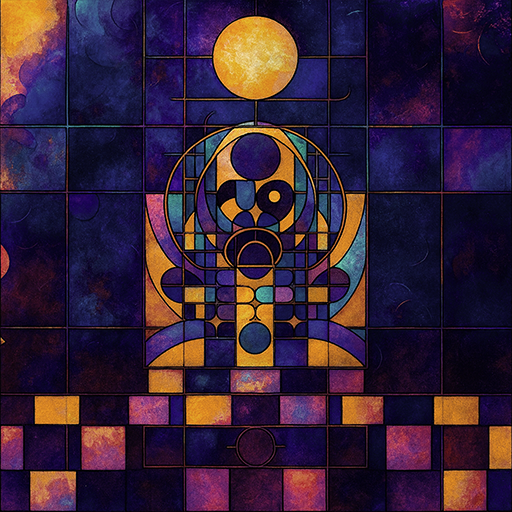
The structured, vertical alignment in the artwork evokes the idea of a staff rooted deeply, providing a foundation from which growth and exploration can occur. The geometric symmetry suggests a centeredness and order, symbolizing how a strong anchor within oneself allows for stability in the face of external challenges. The dark and light contrasts remind us of the dual forces—strength and vulnerability, certainty and doubt—that shape our paths.
This visual meditation on the Staff archetype invites us to contemplate the role of anchoring in our lives. The staff teaches us that grounding ourselves is essential to navigating the unknown and that true strength arises when we cultivate resilience within. The artwork’s interplay of structure and contrast captures the essence of anchoring, encouraging viewers to find their inner center, stand tall in the face of adversity, and trust the steady path they walk. Through this grounding, the staff leads us toward inner peace and unwavering confidence.
For Kayle
Description of The Staff
The Staff carries a sense of steadiness amid motion. It is felt as something leaned upon, grasped, or planted—an assurance of balance when footing is uncertain. There is quiet confidence in its presence, not dramatic strength but reliable endurance. The Staff suggests experience earned over time, offering support without urgency. It does not rush forward; it allows progress to continue without collapse.
Symbolic Attributes ofThe Staff
Support: Capacity to bear weight without absorbing it.
Orientation: Providing direction through reference rather than instruction.
Continuity: Sustained presence across long durations or journeys.
Authority: Stability that commands trust without force.
Rigidity: Resistance to adaptation when conditions demand flexibility.
Dependence: Risk of leaning too heavily on external structure.
Aesthetic Values of the Staff
Vertical Emphasis: Clear axial alignment suggesting grounding and presence.
Symmetry and Balance: Even distribution of form reinforcing stability.
Material Solidity: Visual weight that implies durability and endurance.
Contrast of Light and Dark: Highlighting load-bearing structure through opposition.
Dream Indicators of the Staff
Ego Stabilization: Indicates the psyche seeking balance when navigating unfamiliar or demanding inner terrain.
Reliance on Inner Authority: Reflects the activation of an internal guiding principle rather than external direction.
Psychic Support: Suggests the presence of a sustaining structure within the Self during periods of strain or transition.
Resistance to Change: May signal rigidity in attitude, where stability is maintained at the cost of adaptation.
Compensatory Grounding: Appears when unconscious material threatens equilibrium, prompting the psyche to anchor itself.
Cultural References Aligned with The Staff
Year: ~3000 BCE
Title: The Nile River and the God Hapi
Source: Egyptian Mythology
Quote: "Hapi, lord of the river bringing abundance, who makes the land flourish with his floods."
Explanation: In Egyptian mythology, the Nile River is personified by the god Hapi, who symbolizes fertility, life, and renewal. The river's annual flooding brought rich silt to the land, enabling agriculture to thrive. In Jungian psychology, the river represents the flow of the unconscious mind and the life force. The Nile as a symbol signifies the continuous flow of psychic energy and the potential for growth and transformation within the psyche.
Year: ~500 BCE
Title: Doctrine of Flux
Source: Heraclitus
Quote: "No man ever steps in the same river twice, for it's not the same river, and he's not the same man."
Explanation: Heraclitus uses the river as a metaphor for perpetual change and the transient nature of existence. The river represents the constant flow of life and the evolving self. In Jungian psychology, it symbolizes the dynamic movement of the psyche and the process of individuation—the journey toward personal wholeness and self-realization through embracing change.
Year: 1884
Title: The Adventures of Huckleberry Finn
Author: Mark Twain
Quote: "It's lovely to live on a raft. We had the sky up there, all speckled with stars, and we used to lay on our backs and look up at them."
Explanation: The Mississippi River serves as a central symbol in the novel, representing freedom, adventure, and the journey toward self-discovery. For Huck and Jim, the river is a means of escaping societal constraints. In Jungian terms, the river symbolizes the flow of life and the unconscious journey toward individuation, as the characters confront moral dilemmas and their own identities.
Year: 1922
Title: Siddhartha
Author: Hermann Hesse
Quote: "Have you learned the secret from the river; that there is no such thing as time?"
Explanation: In "Siddhartha," the river represents the essence of life and the path to enlightenment. Siddhartha learns from the river's eternal flow the unity of all existence and the illusion of time. The river embodies the Jungian concept of the collective unconscious and the flow of psychic energy that connects all individuals. It serves as a teacher guiding the protagonist toward self-realization and harmony with the universe.
