The Maze
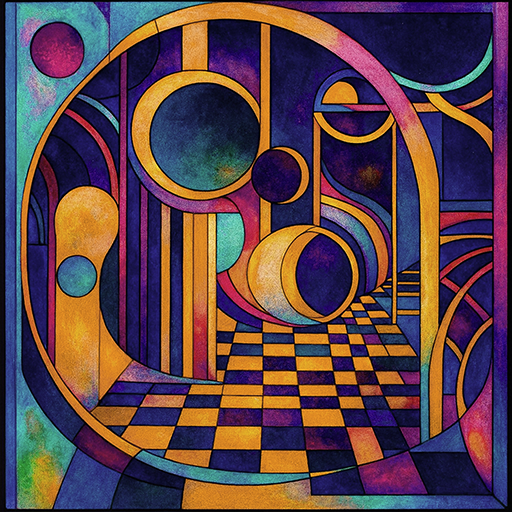
Primary Seed: “Manifold” establishes the Maze as a multidimensional structure composed of locally coherent paths that form a complex whole. In mathematics, a manifold appears simple at close range while revealing greater complexity across scale. The Maze operates the same way: each segment is navigable, yet the total structure resists immediate comprehension.
The Maze is not defined by error or deception, but by structural complexity. Progress depends on orientation, memory, and adaptation rather than force or speed.
For Kayle
Description of the Maze
Moving through the Maze feels mentally demanding and internally noisy. Attention narrows. Decisions multiply. Momentum slows as awareness shifts from destination to navigation.
The emotional tone is one of tension mixed with focus. Small successes feel earned, while missteps amplify frustration. Time stretches. The experience is less about arrival and more about sustaining engagement under cognitive strain.
The Maze produces effort before insight.
Symbolic Attributes of the Maze
Cognitive Load: Represents sustained mental effort under complex conditions.
Multiplicity: Indicates many simultaneous options without clear hierarchy.
Orientation: Reflects the need to track position, progress, and context.
Entrapment: Signals feeling enclosed within self-generated complexity.
Recursive Thought: Represents looping patterns of reasoning.
Perseverance: Marks endurance through uncertainty without immediate reward.
Aesthetic Values of the Maze
Symmetry and Repetition:
Repeating forms emphasize pattern, recursion, and potential looping.Complex Pathways:
nterwoven routes create visual density and navigational ambiguity.Enclosed Environment:
Bounded space reinforces containment and inward focus.
Dream Indicators of the Maze
Mental Saturation: Feeling overwhelmed by options or information.
Problem Fixation: Persistent engagement with unresolved questions.
Disorientation: Loss of clarity about direction or priorities.
Delayed Resolution: Progress without closure.
Cognitive Persistence: Continued effort despite fatigue.
Cultural References Aligned with The Maze
Year: ~1550 BCE
Title: The Journey through the Duat (The Book of the Dead)
Source: Egyptian Mythology
Quote: "The soul must pass through twelve gates, each guarded by serpents and trials, before reaching the Field of Reeds."
Explanation: In Egyptian mythology, the Duat is a labyrinthine underworld that the soul must navigate after death, facing challenges and perils at each stage. The maze-like journey represents the soul's transformation and quest for immortality. In Jungian terms, the maze symbolizes the inner journey through the unconscious, where confronting fears and overcoming obstacles lead to higher consciousness and rebirth.
Year: 1949
Title: "The Myth of the Labyrinth", Existentialism Is a Humanism
Author: Jean-Paul Sartre
Quote: "Man is condemned to be free; within the labyrinth of choices, he must find his own path."
Explanation: Sartre uses the labyrinth as a metaphor for the human condition of existential freedom and responsibility. The maze symbolizes the complex web of choices and the absence of predetermined paths. In Jungian psychology, the maze represents the intricate inner world where one must confront personal freedom, make authentic choices, and navigate the complexities of the self to achieve individuation.
Year: 1986
Title: Labyrinth
Source: Film directed by Jim Henson
Quote: "It's a crystal. Nothing more. But if you turn it this way and look into it, it will show you your dreams."
Explanation: The film features a literal labyrinth that the protagonist, Sarah, must navigate to rescue her brother from the Goblin King. The maze represents her journey of maturation and self-discovery. In Jungian psychology, the labyrinth symbolizes the trials and challenges faced when confronting one's own inner fears, desires, and responsibilities. Sarah's navigation through the maze reflects her psychological growth and the integration of her shadow aspects, leading to individuation.
