The Ocean
Primary Seed: "Continuum" captures the essence of the Ocean archetype, symbolizing the seamless flow of experiences, emotions, and consciousness. In mathematics and physics, a continuum refers to a coherent whole, where any point is connected to the next through an unbroken series—much like the ocean’s waves, where each ripple is part of an expansive and unified body of water. The Ocean archetype reflects both the vastness of the unconscious mind and the fluidity of emotions, inviting us to explore without boundaries.
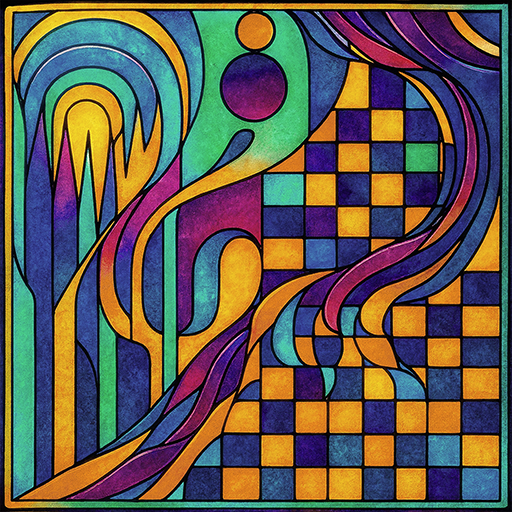
The flowing curves in the artwork evoke the perpetual motion of waves, symbolizing the ebb and flow of life’s experiences. The checkerboard elements suggest that even within a continuum, patterns can emerge, hinting at the rhythms that underlie emotional or psychological states. The juxtaposition of structured lines with organic forms reflects the tension between chaos and order inherent in the Ocean’s depths.
The towering vertical shapes on the left suggest the merging of sky and sea, evoking a sense of connection between the conscious and unconscious mind. This interplay of elements represents the journey inward—where diving into emotional or spiritual depths can yield profound understanding.
This visual meditation on the Ocean archetype encourages viewers to embrace fluidity and the inevitability of change. Just as a continuum contains infinite points connected across time and space, the Ocean reminds us that all emotions, experiences, and phases of life are interconnected. Through its balance of structure and flow, the artwork invites us to surrender to the rhythms of life, trusting that the currents will carry us toward insight and renewal.
For Kayle
Description of the Ocean
The ocean feels immense and impersonal, yet intimate once entered. It can be calming or disorienting, offering both surrender and resistance. Standing at its edge evokes humility; immersion dissolves orientation. Movement is constant but not hurried, and depth is sensed more than seen. The ocean does not respond to control—it absorbs, carries, and reshapes what enters it.
Symbolic Attributes of the Ocean
Continuity: Experience without clear beginnings or endings, where states blend rather than divide.
Immersion: Loss of fixed reference points, allowing full absorption into sensation or feeling.
Generativity: Source conditions from which forms, ideas, and emotions arise.
Overwhelm: Excess input without boundaries, leading to emotional saturation.
Dissolution: Erosion of identity or structure through prolonged exposure.
Unknowability: Presence of depth that resists full comprehension or mastery.
Aesthetic Values of the Ocean
Horizon Line: Establishes scale while denying closure, extending perception outward.
Surface Motion: Continuous variation without repetition, suggesting living texture.
Depth Gradient: Visual falloff from clarity to opacity, implying layered space.
Light Absorption: Shifting reflectivity that changes with angle and time.
Dream Indicators of the Ocean
Emotional Depth: Reflects the dreamer's internal emotional state, with the calm or turbulence of the water indicating balance or turmoil.
Exploration of the Unconscious: Suggests a journey into hidden aspects of the psyche, seeking deeper understanding or confronting unresolved emotions.
Fear of the Unknown: Indicates anxiety about navigating the uncertainties of life and the challenges of emotional growth.
Cultural References Aligned withThe Ocean
Year: ~2100 BCE
Title: Tiamat, Primordial Goddess of the Ocean
Source: Babylonian Mythology Enuma Elish
Quote: "From the turbulent waters of Tiamat, all creation was born."
Explanation: Tiamat is the personification of the saltwater ocean and chaos. Her story represents the cosmic struggle between order and disorder. In Jungian terms, the ocean symbolizes the unconscious mind's chaotic and creative potential. Tiamat's narrative reflects the process of confronting and integrating the shadow aspects of the psyche to achieve balance and self-realization.
Year: ~13th century
Title: Jörmungandr (The Midgard Serpent)
Source: Prose Edda
Quote: "Jörmungandr, the serpent so large it encircles the world, biting its own tail beneath the ocean's depths."
Explanation: The ocean where Jörmungandr resides symbolizes the collective unconscious—vast, mysterious, and encompassing all human experience. The serpent biting its tail represents the cyclical nature of life and the self-contained psyche. In Jungian terms, the ocean embodies the unconscious mind's depths, and the serpent signifies the forces that can both threaten and lead to wholeness.
Year: 1851
Title: Moby-Dick
Author: Herman Melville
Quote: "There is, one knows not what sweet mystery about this sea, whose gently awful stirrings seem to speak of some hidden soul beneath."
Explanation: In Moby-Dick, the ocean symbolizes the unfathomable depths of the unconscious and the mysteries of existence. Captain Ahab's obsessive quest to conquer the white whale represents a struggle against his inner demons and fate. The ocean's vastness reflects the collective unconscious in Jungian psychology, with the novel exploring themes of obsession, the limits of knowledge, and the conflict between the conscious ego and the immense forces within the psyche.
Year: 1818
Title: The World as Will and Representation
Author: Arthur Schopenhauer
Quote: "Just as the wave is nothing other than the form which the water assumes for a moment, so all mortal things are only modifications of the one essence."
Explanation: Schopenhauer compares individual phenomena to waves on the ocean, emphasizing the illusory nature of individuality. The ocean symbolizes the underlying reality—the will—that manifests through all existence. In Jungian terms, recognizing oneself as part of the vast ocean of the collective unconscious can lead to a deeper understanding of the self beyond the ego, promoting integration and wholeness.
