The River
Primary Seed: "Flux" encapsulates the essence of the River archetype, symbolizing the constant flow of life, emotions, and time. In physics, flux refers to the rate of flow through a surface or space, capturing the dynamic and ever-changing nature of reality. The River archetype embodies movement and transformation, reminding us that nothing remains static, and life’s currents continuously shape our experiences.
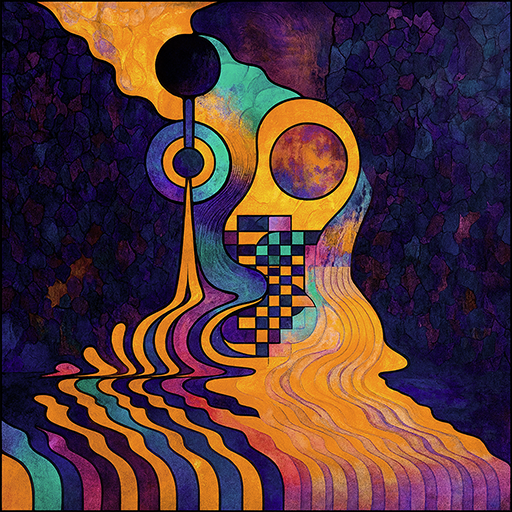
The artwork’s flowing lines represent the undulating motion of water, suggesting the River’s capacity to carve new paths through even the most rigid landscapes. The circular motifs evoke the cyclical nature of emotions and time—how each phase of life feeds into the next, contributing to a larger flow. The checkerboard pattern adds a sense of structure to the otherwise fluid design, suggesting that while the River is unpredictable, there is an underlying pattern to its movements.
The contrast between light and dark, as well as the interplay between fluid and structured elements, reflects the duality inherent in the River’s symbolism. It represents both chaos and order, both freedom and constraint, as we navigate through life's emotional and experiential currents.
This visual meditation on the River archetype invites contemplation on how we adapt to change. The River teaches that life’s most profound transformations occur when we allow ourselves to be carried by its current, trusting that each twist and turn brings us closer to growth and understanding. The artwork’s dynamic forms capture the essence of flux, encouraging viewers to embrace the flow of life and the ever-evolving journey of self-discovery. Through movement and transformation, the River leads us toward emotional depth and renewal.
For Kayle
Description of the River
The River carries a sense of inevitability. It moves whether noticed or not, shaping its surroundings through persistence rather than force. There is comfort in its sound and unease in its momentum—once entered, it does not stop for reflection. The River feels alive with time: memories surface, dissolve, and are replaced as the current advances. To stand beside it is to feel both continuity and loss, a quiet reminder that experience cannot be held, only passed through.
Symbolic Attributes of the River
Continuity: Sustained movement that links moments without rupture.
Transmission: The carrying of influence, memory, or consequence from one state to another.
Adaptation: Capacity to alter form while maintaining direction.
Erosion: Gradual wearing down through repeated contact over time.
Loss of Control: Surrender to momentum once engagement begins.
Irreversibility: Inability to return to a prior state after passage.
Aesthetic Values of the River
Directional Flow: Emphasis on forward movement through line and form.
Variable Width and Speed: Visual shifts that suggest acceleration and slowing without stopping.
Integration with Terrain: The River’s shape responds to its environment rather than opposing it.
Surface Patterning: Repetition and variation that indicate motion across time.
Dream Indicators of the River
Emotional Flow: Indicates the dreamer’s current emotional state, with calm waters suggesting peace and turbulence indicating inner conflict.
Life’s Journey: Represents the dreamer's path of experiences and transitions, guiding them through growth and change.
Transition and Change: Reflects periods of adaptation or movement from one stage of life to another, symbolized by the river’s passage.
Cultural References Aligned withThe River
Year: ~3000 BCE
Title: The Nile River and the God Hapi
Source: Egyptian Mythology
Quote: "Hapi, lord of the river bringing abundance, who makes the land flourish with his floods."
Explanation: In Egyptian mythology, the Nile River is personified by the god Hapi, who symbolizes fertility, life, and renewal. The river's annual flooding brought rich silt to the land, enabling agriculture to thrive. In Jungian psychology, the river represents the flow of the unconscious mind and the life force. The Nile as a symbol signifies the continuous flow of psychic energy and the potential for growth and transformation within the psyche.
Year: ~500 BCE
Title: Doctrine of Flux
Source: Heraclitus
Quote: "No man ever steps in the same river twice, for it's not the same river, and he's not the same man."
Explanation: Heraclitus uses the river as a metaphor for perpetual change and the transient nature of existence. The river represents the constant flow of life and the evolving self. In Jungian psychology, it symbolizes the dynamic movement of the psyche and the process of individuation—the journey toward personal wholeness and self-realization through embracing change.
Year: 1884
Title: The Adventures of Huckleberry Finn
Author: Mark Twain
Quote: "It's lovely to live on a raft. We had the sky up there, all speckled with stars, and we used to lay on our backs and look up at them."
Explanation: The Mississippi River serves as a central symbol in the novel, representing freedom, adventure, and the journey toward self-discovery. For Huck and Jim, the river is a means of escaping societal constraints. In Jungian terms, the river symbolizes the flow of life and the unconscious journey toward individuation, as the characters confront moral dilemmas and their own identities.
Year: 1922
Title: Siddhartha
Author: Hermann Hesse
Quote: "Have you learned the secret from the river; that there is no such thing as time?"
Explanation: In "Siddhartha," the river represents the essence of life and the path to enlightenment. Siddhartha learns from the river's eternal flow the unity of all existence and the illusion of time. The river embodies the Jungian concept of the collective unconscious and the flow of psychic energy that connects all individuals. It serves as a teacher guiding the protagonist toward self-realization and harmony with the universe.
